When a source of sound is moving toward a stationary detection the frequency of sound perceived by the detector is not the same as the emitted by the source. In order to see this quantitatively, consider the time T elapsed between the emissions of a successive pair of spherical wave fronts (see figure 1). A Source moving with speed v s emits the first wave front. At this point, the first wave front has already traveled a distance vT, where v = 340 m/s is the speed of sound. Therefore, the wavelength detected along the direction of motion is given by the difference λ’ = vT – v s T. Using the fact that λ’f’ = λϕ = v and T = 1/f, we find that the shifted frequency f’ perceived by the detector is f’ = fv/(v – v s ).
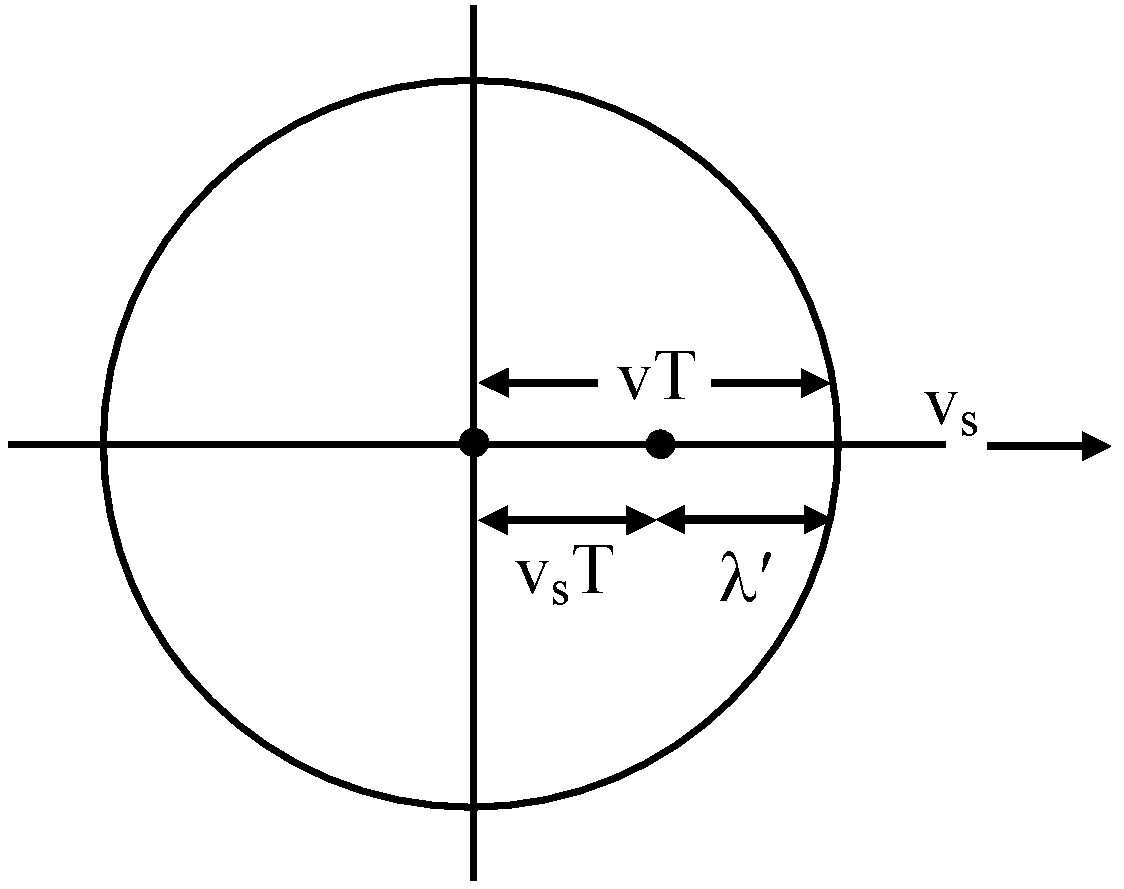
Fig. (1)
The previous equation does not describe situations where v s  v. When the source travels faster than the speed of sound, a shock wave is produced by the spherical wave fronts. Figure 2 shows the spherical wave fronts produced by such a source at equally spaced positions over an arbitrary time t. During this time, the source travels a distance v s t, and the first wave front travels a distance vt. However, in this case, the source emits each new wave after traveling beyond the front of the previously emitted wave. The wave fronts bunch along the surface of a cone called the match cone. The resulting rise and fall in air pressure as the surface of the cone passes through a point in space produces a shock wave.

Fig. (2)
(i) A roller skater carrying a portable stereo skates at constant speed an observer at rest. Which of the following accurately represents how the frequency perceived by the observer changes with time?
Text Solution
Verified by Experts(i) Sol; (ii) Sol; (iii) Sol
(i)
Sol. When the skater is approaching the observer.
f 1 = f  > f and constant.
When it recedes from the observer.
f 2 = f  < f and constant.
(ii)
Sol. f’ = f 
 f = f’
  = 1030
 1000 Hz
(iii)
Sol. The wall in such situations is treated as a mirror (for reflected waves). It can be assumed that image of bat i.e., B’ is moving him with same velocity v b . Now, the situation is: both source and observer are moving towards each other same velocity v b .

Prepare Smarter with CGP Edu
Get practice questions, solutions, and test series in one place.
Write a Review
Share your experience with this question and solution.
Commentary
Send your comment, doubt, correction, or feedback to admin.
Similar Questions
Explore conceptually related problems